


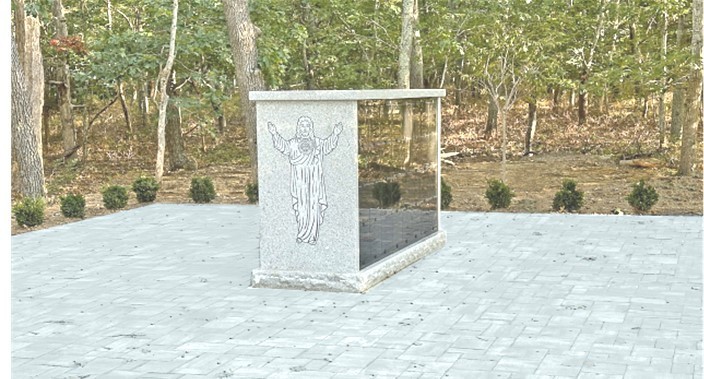
The Sacred Heart Columbarium Is Now available in St. Patrick's Cemetery
There are sixty-four niches available. Each niche measures 12"x 13"x 15". The cost is $1,800.
Understanding the Sacred Heart Columbarium - St. Patrick's Cemetery
The proverb, “death is the echo of life” suggests that the manner of a person’s death often reflects the manner of that person’s life. In addition, death echoes life in that the values that govern life in each culture are reflected in its funeral customs as well.
For the Christian, the experience of death, no less than the experience of life, is understood in the light of Christ’s Resurrection. Indeed, for the believer, death is the ultimate passage into the fullness of life with Jesus Christ.
As such, early believers sought to bring this belief in the paschal mystery into all aspects of their lives, including the sacraments and the liturgy.
Although cremation was practiced among the Greeks and Romans of the early Christian era, Christians buried their dead for three major reasons:
- reverence for the body as a member of Christ and a temple of the Holy Spirit
- faith in its resurrection
- a strong reaction against the burning of bodies by pagan persecutors as a taunt against belief in the resurrection.
The disposal of the remains from cremation often took two forms:
- Underground cemeteries (also known as catacombs) were made possible due to a type of subsoil called (tufa granolare) produced in prehistoric times by volcanic activity around Rome. This tufa was strong, porous, and easily pliable – perfect for burials underground. Catacombs are also found in Naples, Sicily, Malta, North Africa, and elsewhere. Burying underground was due either to the fact that the surface had been used up for graves, or because underground chambers had to be enlarged.
Burial was by inhumation, a practice that Christians inherited from the Jewish tradition. The body was placed in a rectangular opening carved out of the side of a corridor wall or room and was sealed with a marble slab of bricks covered with plaster and these were often decorated with inscriptions or frescoes. These decorations are seen as the beginning of Christian art. The art and inscriptions in the catacombs attest to a faith in eternal life and in the resurrection of the body.
Unlike other ancient people, Christians were not buried with precious mementos to the chagrin of the barbarian grave robbers who wreaked much damage on these graves. The principal catacombs in Rome are Priscilla and Domitilla (begun before 150) and Callistus (ca. 200). All lost catacombs have been found except one. There are 35 catacombs in Rome alone. - The second form of burial was in the construction and use of a Columbarium. A columbarium is defined as a “vault or similar structure with recessed niches in the wall for storing the ashes of the dead. In modern facilities, the niches are faced with protective glass, bronze or marble.
In addition to its call for the revision of the liturgy, the Vatican Council also included the funeral rites of the Church that would express more clearly the paschal character of Christian death and correspond more closely to the circumstances and traditions found in different regions of the world.
Parish Priests and Catholics sometimes ask what is liturgically appropriate for the disposition of ashes (also referred as cremains). Because ashes deserve the same respect as buried remains, pastors often urge the people who request cremation to make arrangements to preserve their ashes in a cemetery rather than having them scattered over the countryside or ocean, especially if there is a family plot that members of the family will remember and visit. Some parishes have established a parish columbarium to ensure such respect.
The Catholic Church modified this tradition and law in 1963. Cremation had been permitted only for the rapid disposal of bodies in times of pestilence, natural disaster, or other grave public necessity. Now it could be allowed for any sound reason, provided the request was not motivated by any denial of Christian beliefs, or hatred of the Church. The major factors in the change arose from a renewal of the theology of the resurrection and the increasing environmental concern for the use of land resources for the burial of the dead. Subsequent Church statements (1963, 1989) make provision for both cremation and the interment of ashes.
Although Catholic directives have not taken up the manner of disposing of the ashes after cremation, the role of the cemetery continues in the memory of Christians as a pledge of resurrection. In the minds of many, this suggests a certain preference for preserving the ashes in a columbarium.